Timezone Twists: How Travel Fatigue Rewrites Team Records in Cross-Continental Leagues
Written by Eden Lange · Aug 18, 2026
Timezone Twists: How Travel Fatigue Rewrites Team Records in Cross-Continental Leagues
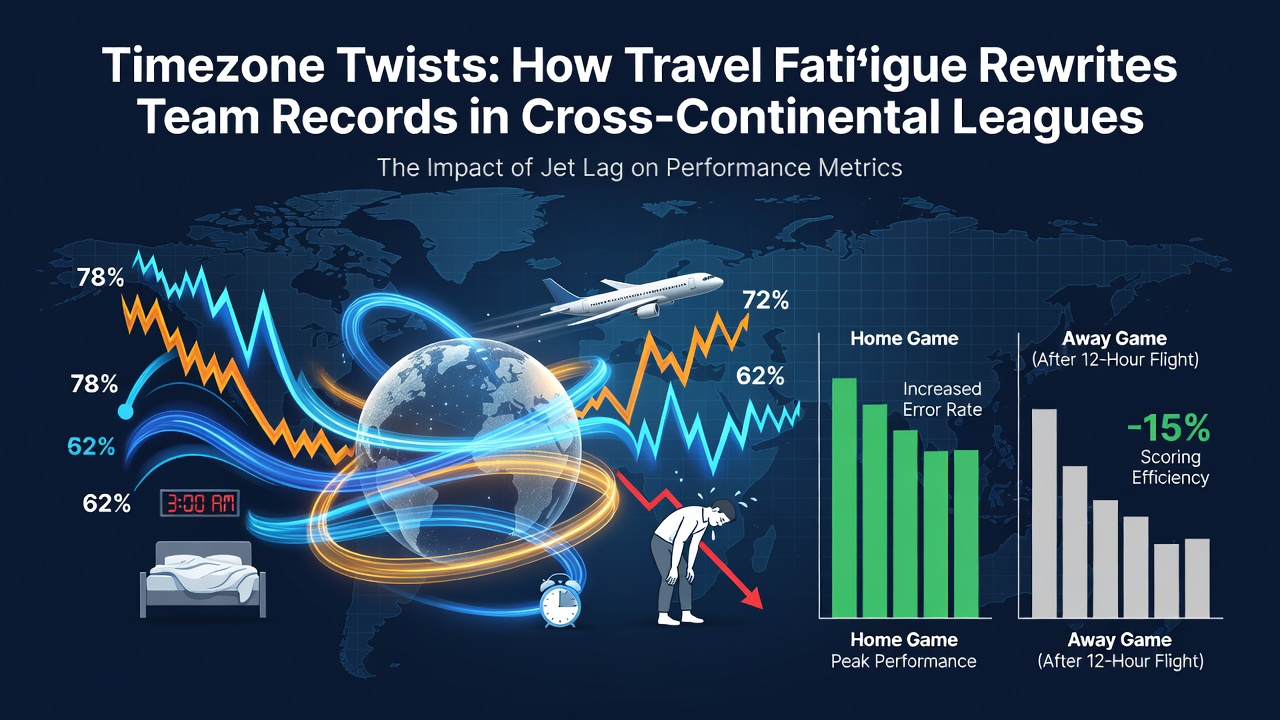
Cross-continental leagues such as the NBA, MLB, and NHL operate across multiple time zones within North America while some teams also contend with international fixtures that extend journeys even further, and data from performance tracking systems shows consistent patterns where travel distance and circadian disruption correlate with shifts in win rates and individual player statistics. Researchers at institutions including the University of Sydney have documented how westward travel tends to produce more pronounced effects on sleep cycles than eastward movement because the body must adjust to a longer day, and league schedules place teams in situations where recovery windows shrink to as little as 24 hours between games played in cities separated by three or more zones.
Patterns in Performance Data Across Major Leagues
Studies compiled by the National Institutes of Health indicate that teams traveling more than 1,500 miles east-to-west experience measurable declines in shooting accuracy and defensive reaction times during the first 48 hours after arrival, while the same distance traveled westward produces smaller but still detectable drops in scoring output. In the NBA, for example, back-to-back road games that cross two time zones have shown home teams holding a 3.2 percent higher win percentage on average according to season-long aggregates maintained by league statisticians, and similar trends appear in MLB where starting pitchers who cross the Mississippi River westward post earned-run averages that rise by 0.45 runs per nine innings in their immediate follow-up starts.
Those who analyze NHL schedules note that Pacific Division clubs visiting Eastern Conference opponents frequently encounter compressed rest periods because flights from Vancouver or Seattle land in cities like Boston or New York after crossing three zones, and injury surveillance data from the league’s medical database reveals elevated rates of soft-tissue strains in the 72-hour window following such trips. August 2026 preseason preparations already reflect adjustments by front offices that now incorporate mandatory light-exposure protocols and scheduled naps on charter flights to mitigate these documented effects.
Mechanisms Behind Record Shifts
Circadian misalignment affects hormone regulation, particularly melatonin and cortisol levels, which in turn influence muscle recovery and cognitive processing speed, and physiological monitoring studies conducted across European and North American research centers confirm that athletes require between three and five days to fully realign internal clocks after crossing four or more time zones. When leagues compress schedules to maximize television revenue, the recovery interval often falls short of that threshold, producing cumulative fatigue that surfaces in box-score metrics such as turnovers per game or goals allowed in the third period.

One analysis of MLB road-trip outcomes found that clubs arriving in a new time zone the morning before a night game surrendered 12 percent more extra-base hits in the first two innings compared with games played after a full day of acclimatization, and parallel findings in the NBA show reduced three-point percentages among perimeter players during the opening quarter of the second game in a back-to-back set. Observers tracking these variables emphasize that the effect compounds when teams play three games in four nights across different zones, a sequence that appears multiple times each season in both conferences.
League-Specific Adjustments and Scheduling Tools
Front-office personnel in the NHL have begun integrating sleep-science consultants into travel planning, drawing on protocols developed by Australian sports institutes that emphasize timed light exposure and meal timing to accelerate adaptation, and the NBA has expanded its use of wearable devices that log heart-rate variability to flag players whose recovery metrics fall below baseline thresholds before tip-off. MLB clubs meanwhile adjust bullpen usage patterns for pitchers returning from West Coast swings, shifting high-leverage appearances away from the first 24 hours after arrival when velocity readings typically dip by 1.5 to 2 miles per hour according to Statcast archives.
These operational changes coincide with broader league efforts to refine travel logistics, including charter-flight routing that minimizes connections and hotel selections that prioritize blackout curtains and controlled lighting environments, yet the fundamental constraint of geography and fixture density remains unchanged. Data aggregated by the Canadian Institute for Health Research further suggests that younger athletes, those under age 25, demonstrate slightly faster adaptation rates than veterans, which has prompted some organizations to alter rotation patterns for rookies on long road swings.
Conclusion
Performance databases across the NBA, MLB, and NHL consistently record measurable impacts from cross-continental travel on both team win percentages and individual statistical outputs, and ongoing research continues to refine mitigation strategies that range from physiological monitoring to schedule optimization. As leagues prepare for the 2026-27 seasons, the interplay between time-zone shifts, recovery windows, and record outcomes remains a central variable that medical and analytics staffs address through evidence-based protocols rather than anecdotal adjustments.