Shifting the Scouting Paradigm: Late-Round Picks That Changed the Game in Football, Basketball, and Baseball
Written by Yves Hoffmann · Jun 30, 2026
Shifting the Scouting Paradigm: Late-Round Picks That Changed the Game in Football, Basketball, and Baseball
Scouting departments across professional leagues have long prioritized measurable traits such as speed, size, and athletic testing results, yet certain late-round selections have prompted organizations to expand their evaluation criteria. These players demonstrated that production, decision-making, and adaptability can outweigh early projections, leading teams to adjust their processes in football, basketball, and baseball.
Football: Quarterback Evaluation Expands Beyond Physical Tools
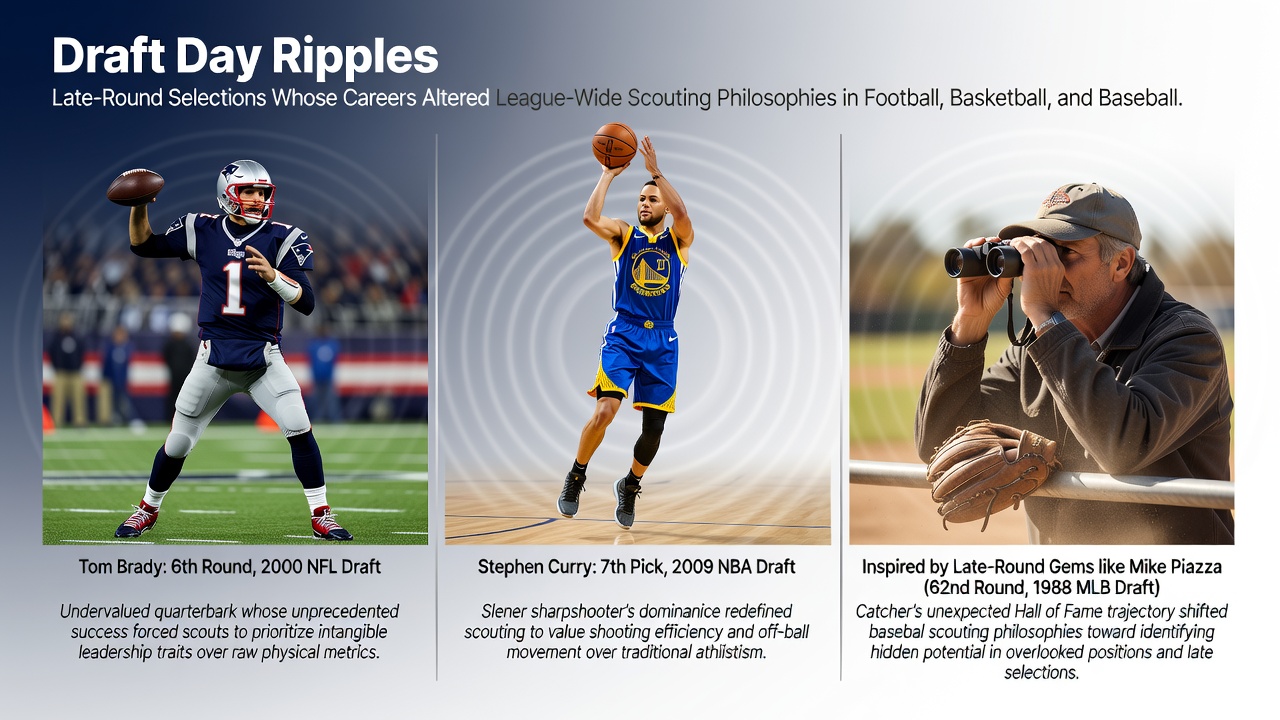
The New England Patriots selected Tom Brady in the sixth round of the 2000 NFL Draft, a move that initially drew limited attention but later influenced how teams assessed quarterbacks. Brady's career included multiple Super Bowl appearances and a record of sustained performance that highlighted film study and leadership as key indicators. Observers note that subsequent drafts saw increased emphasis on mental processing and pocket presence, with organizations incorporating more detailed quarterback-specific interviews and practice observations into their workflows.
Similar patterns emerged with other selections, including several offensive linemen and defensive players chosen after the third round who became starters on championship teams. Data from league tracking shows a rise in the number of late-round contributors reaching Pro Bowl status between 2010 and 2025, prompting analytics departments to integrate advanced metrics such as pressure rates allowed and route-running efficiency earlier in the evaluation cycle.
Basketball: Role Players and Versatility Gain Priority
In the NBA, selections like Draymond Green in the second round of the 2012 draft and other overlooked prospects have shifted focus toward multi-positional defenders and high basketball IQ. Teams began placing greater weight on college assist-to-turnover ratios and defensive versatility after these players contributed to multiple championship runs. Scouting reports from that era started incorporating more granular data on help defense rotations and transition decision-making.
By the mid-2020s, front offices across the league adjusted their pre-draft workouts to include more situational drills that test adaptability rather than isolated athletic testing. Research from academic institutions tracking player development has documented how these changes correlated with improved team defensive efficiency ratings in the seasons following the initial successes of such players.
Baseball: Power and Plate Discipline Over Raw Tools
Baseball offers clear examples through players such as Mike Piazza, selected in the 62nd round of the 1988 MLB Draft, whose offensive production prompted organizations to reexamine catcher evaluations. Scouts began prioritizing on-base percentage and power output in later rounds, leading to increased investment in hitting instruction for prospects who lacked elite throwing arm strength. This adjustment influenced how amateur and international scouting departments structured their reports, with more emphasis placed on swing mechanics and pitch recognition data.
Throughout the 2010s and into 2026, teams integrated wearable technology and biomechanical analysis to identify similar profiles earlier. Figures from industry tracking services reveal that the proportion of home run leaders drafted after the 10th round increased during this period, reflecting broader acceptance of performance-based models alongside traditional physical assessments.
League-Wide Adjustments in Evaluation Practices
Organizations responded to these outcomes by expanding their scouting staffs to include more data analysts and sports scientists. Pre-draft combines now feature additional cognitive testing protocols, while international scouting networks have grown to capture players who develop later than their peers. In June 2026, several teams entered their respective drafts with updated boards that de-emphasize early-round athletic outliers in favor of prospects showing consistent production across multiple seasons.
These shifts have produced measurable changes in draft strategies, with increased trading activity around mid-round picks as teams seek to acquire additional selections. External reports from research groups such as those affiliated with Sport Canada and university studies on talent identification have examined how late-round success rates affect overall roster construction across North American leagues.
Conclusion
Late-round selections continue to demonstrate that scouting philosophies evolve when performance contradicts initial projections. Football, basketball, and baseball organizations have incorporated broader datasets and situational evaluations as a direct result, creating more comprehensive processes that balance physical tools with demonstrated on-field impact. These adjustments remain evident in current draft preparations and roster-building approaches.