Quietly Dictating the Play: How Venue Environments Guide Tactics in Baseball, Football, Hockey, and Soccer
Written by Quinn Baumann · Aug 18, 2026
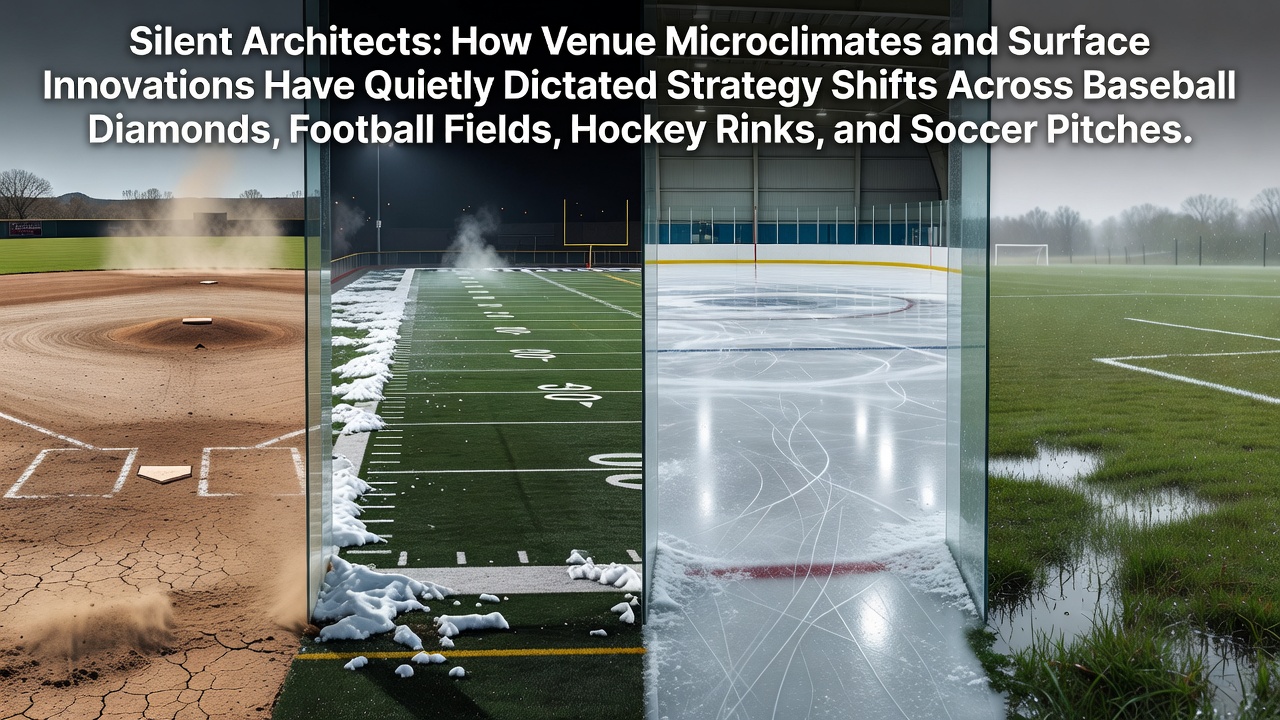
Quietly Dictating the Play: How Venue Environments Guide Tactics in Baseball, Football, Hockey, and Soccer
Venue microclimates and surface innovations continue to shape player positioning, equipment choices, and in-game adjustments across baseball diamonds, football fields, hockey rinks, and soccer pitches. Data collected from league monitoring programs show that temperature gradients inside domed and open-air facilities alter ball flight paths and puck behavior, prompting coaches to revise offensive schemes accordingly. Researchers at the Australian Institute of Sport documented wind patterns inside retractable-roof stadiums that reduce effective batting averages by measurable margins during late-inning play.
Baseball Diamonds and Variable Surface Responses
Grass height and soil moisture levels at major league parks dictate ground-ball trajectories and infield defense alignments. Grounds crews adjust mower settings and irrigation cycles daily based on humidity readings taken at multiple points across each diamond. Studies from the University of British Columbia indicate that faster infield surfaces increase double-play conversion rates when infielders shift their positioning two steps closer to the baseline. Pitchers respond by favoring breaking balls that stay low, while hitters adapt launch angles to clear higher outfield walls when turf dries and hardens.
Football Fields and Climate-Driven Personnel Decisions
Artificial turf systems installed in northern stadiums retain heat differently than natural grass fields used in southern markets. Temperature sensors embedded beneath playing surfaces record afternoon readings that exceed ambient air temperatures by several degrees, influencing substitution patterns during extended drives. Defensive coordinators call more zone coverages on hotter surfaces because fatigue metrics rise faster among defensive linemen, according to tracking data compiled by league medical staffs. Special-teams units adjust kickoff angles and hang times when surface friction changes after rainfall.
Hockey Rinks and Ice-Quality Variables
Indoor rinks maintain ice thickness and temperature through computerized refrigeration loops that respond to crowd density and external humidity. Thinner ice sections near goal lines allow faster puck movement but increase the risk of chipping during heavy traffic periods. Analysts tracking NHL performance logs note that teams using quicker transition offenses gain advantages when ice temperature drops below standard thresholds. Goalies modify butterfly angles and pad angles to compensate for altered rebound distances on freshly resurfaced sections.
Soccer Pitches and Strategic Formation Shifts
Grass species selection and root-zone aeration programs affect ball roll speed and player footing across international and domestic leagues. Pitch maintenance reports shared between clubs reveal that longer grass lengths slow attacking sequences and favor compact defensive blocks. Midfielders receive instructions to play shorter passes when surface moisture readings climb above established benchmarks. Data from UEFA technical reports show teams alter pressing triggers and width of attack based on measured friction coefficients recorded before kickoff.

Integrated Monitoring Systems and Real-Time Adjustments
Stadium operators now deploy networks of sensors that feed live readings on wind speed, humidity, and surface temperature directly to coaching tablets. These streams allow managers to request specific warm-up drills or equipment modifications minutes before scheduled starts. In August 2026 several venues implemented upgraded microclimate dashboards that combine satellite weather feeds with on-site measurements to predict second-half conditions more accurately. Teams incorporate the resulting forecasts into pre-game scouting packets so players know when to expect changes in bounce or grip.
Equipment and Training Adaptations
Manufacturers have introduced cleat patterns and skate blade profiles calibrated to common surface conditions at specific venues. Training staff review historical performance splits tied to each stadium's environmental profile and design drills that simulate those exact friction and temperature combinations. Pitchers and kickers practice on replica surfaces that replicate home-venue characteristics during road trips. Strength coaches adjust workload schedules when projected heat retention on artificial fields exceeds established safety thresholds.
Conclusion
League-wide datasets confirm that venue-specific conditions remain a consistent factor in strategic planning across the four major sports. Surface composition and localized climate patterns continue to influence personnel groupings, formation choices, and in-game adjustments without drawing widespread attention. Ongoing sensor integration and maintenance standardization efforts provide teams with repeatable information they apply when preparing for each unique environment.