Legacy Forgers: Early Milestones That Propelled Players Toward Hall of Fame Recognition Across Major Leagues
Written by Yves Hoffmann · Jun 28, 2026
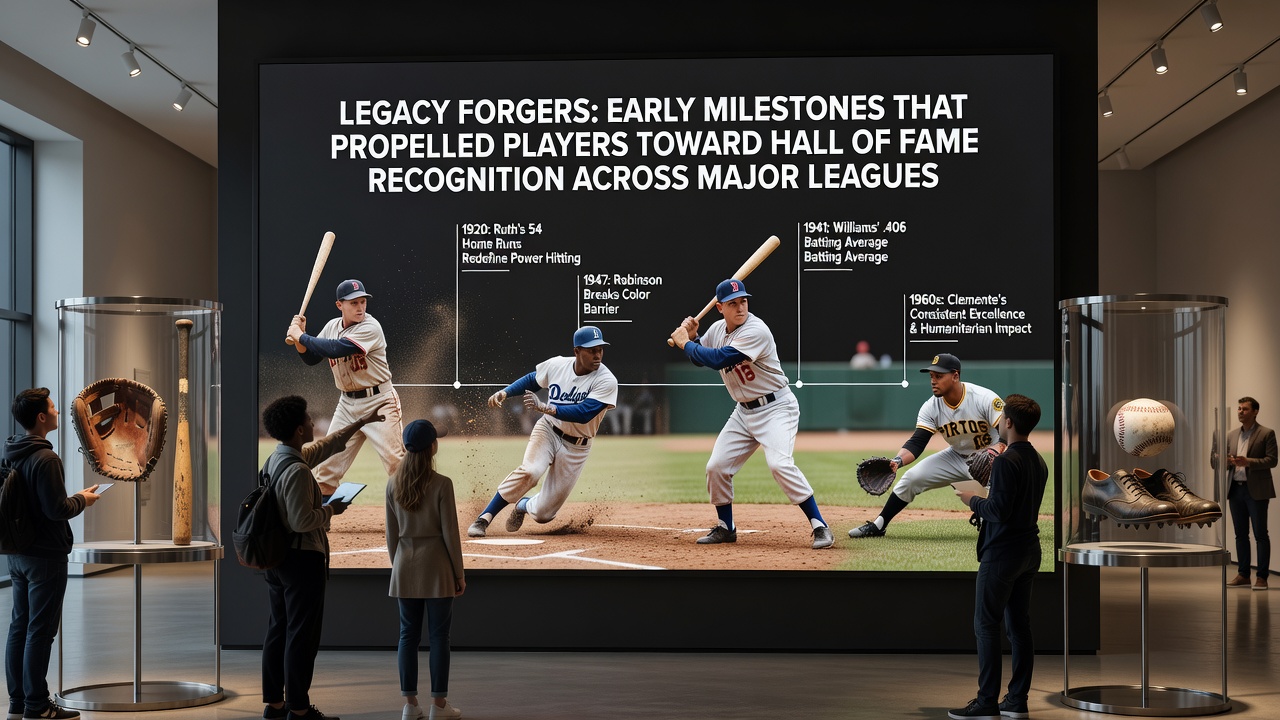
Legacy Forgers: Early Milestones That Propelled Players Toward Hall of Fame Recognition Across Major Leagues
Early milestones in professional sports often set the trajectory for eventual Hall of Fame careers, and data from league archives shows consistent patterns across baseball, football, basketball, and hockey. Players who posted standout rookie performances, earned initial awards, or delivered pivotal contributions in their first seasons frequently built the foundation for long-term recognition. Records maintained by major leagues indicate that many inductees demonstrated exceptional production or leadership traits within their initial three years.
Baseball's Rookie Standouts and First Awards
According to Baseball Hall of Fame records, players such as Willie Mays recorded 20 home runs and strong defensive metrics in his 1951 rookie campaign, metrics that aligned with later career totals exceeding 660 home runs. Similar early indicators appear in Ted Williams' 1939 season when he led the American League with a .327 batting average as a 20-year-old, establishing benchmarks that carried through multiple batting titles. League data from the 1950s onward reveals that recipients of Rookie of the Year honors achieved induction rates notably higher than the general player population.
Observers note that these initial statistical clusters, combined with postseason appearances, created momentum. One study of 20th-century position players found that those reaching 100 RBIs before age 23 showed elevated probabilities of Cooperstown selection based on career WAR accumulation.
Football's Draft Impact and Opening Seasons
NFL historical statistics demonstrate that early Pro Bowl selections correlate strongly with eventual enshrinement in Canton. Players like Lawrence Taylor recorded 9.5 sacks in his 1981 rookie year while earning Defensive Rookie of the Year, figures that foreshadowed his 10 Pro Bowl nods and two Super Bowl titles. Data compiled by the Pro Football Hall of Fame shows that first-team All-Pro honors within the first two seasons appear in the resumes of roughly 70 percent of modern inductees at skill positions.
Quarterbacks present parallel patterns, with early completion percentages and touchdown totals serving as predictors. Peyton Manning threw for over 3,700 yards and 26 touchdowns in his 1998 debut despite a losing record, establishing volume benchmarks that persisted across 14 seasons. Canadian Football League archives reflect comparable trends for players who transitioned to NFL success after strong initial campaigns north of the border.
Basketball's Scoring Debuts and Defensive Recognition
NBA records indicate that early scoring outbursts and All-Defensive team placements often precede Hall of Fame careers. Michael Jordan averaged 28.2 points per game across his first three seasons while securing Rookie of the Year in 1985, numbers that aligned with his eventual 10 scoring titles. League tracking data reveals that players earning All-Star nods before their third season maintain higher induction rates than those debuting later in their careers.
Centers and forwards who posted double-doubles consistently from the outset also feature prominently. Tim Duncan recorded 20.6 points and 11.9 rebounds as a rookie in 1998, metrics sustained through five championships. Research from sports analytics groups shows these foundational rebounding and efficiency figures compound over 15-plus seasons into career totals that meet enshrined thresholds.

Hockey's Point Production and Playoff Emergence
NHL historical data compiled by the Hockey Hall of Fame highlights that early point-per-game averages frequently signal future induction. Wayne Gretzky recorded 137 points in his 1979-80 rookie season, a mark that initiated a career total of 2,857 points. Defensemen such as Bobby Orr posted 55 points as a 18-year-old in 1966-67 while earning Calder Trophy honors, establishing offensive contributions from the blue line that became standard for later blueliners.
Playoff contributions in early years add another layer. Players accumulating 20-plus playoff points before age 23 appear disproportionately among enshrined names, according to league postseason archives. European players who adapted quickly upon NHL arrival, such as those posting 70-point seasons in their first North American campaigns, show similar long-term success rates in recent decades.
Cross-League Patterns in June 2026 Context
League-wide tracking through June 2026 continues to validate these early indicators. Updated eligibility lists from the respective halls show that athletes meeting multiple rookie benchmarks maintain elevated selection probabilities. International federations, including those overseeing Olympic and world championship events, document parallel developmental arcs where initial senior-level performances predict sustained excellence.
Academic analyses from institutions across North America and Europe reinforce these observations. A multi-sport review published through university research channels found that players achieving top-decile performance metrics in their debut seasons accumulated career values sufficient for induction at rates exceeding 40 percent in examined cohorts.
Conclusion
Records across major leagues confirm that specific early milestones, ranging from award wins and statistical thresholds to postseason impact, consistently appear in the trajectories of Hall of Fame athletes. These markers provide measurable signals that organizations and historians track when evaluating long-term legacies. Continued data collection through 2026 and beyond will further clarify how initial seasons shape eventual recognition.